Table of contents
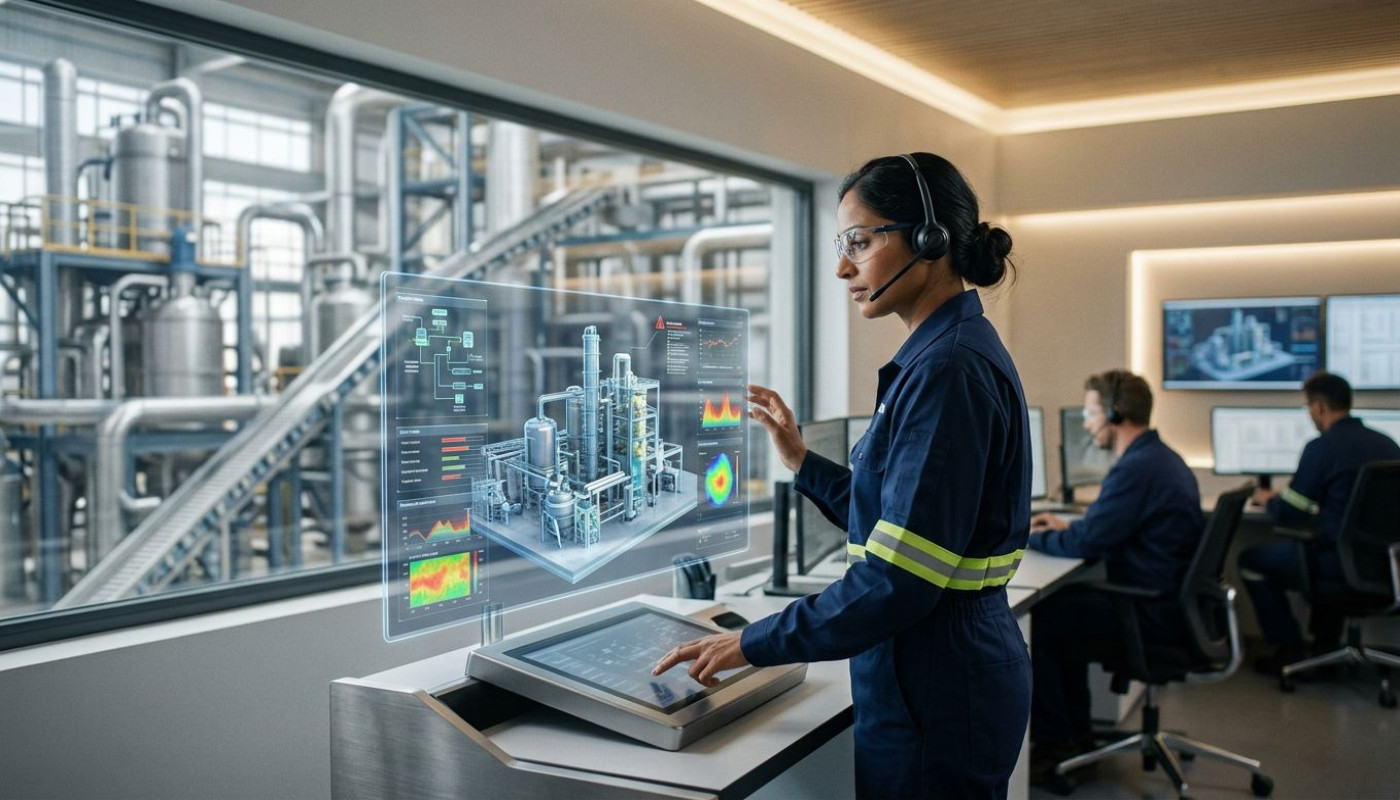
Factory floors are being rewired in real time, not with new conveyor belts but with data, and the shift is accelerating as industrial groups chase resilience after years of supply shocks and energy volatility. Digital twins, virtual replicas continuously fed by sensors and production systems, are moving from pilot projects to daily decision tools. The promise is concrete: fewer stoppages, better quality, and faster engineering changes, while regulators and customers demand traceability and lower emissions. But what does “twin-driven” work actually change, hour by hour, in industrial engineering?
From dashboards to decisions on the shopfloor
Imagine seeing a bottleneck before it happens. That is the practical leap digital twins are trying to deliver, and in many plants the first impact is not glamorous but decisive: operations teams stop arguing over whose numbers are correct. A twin can unify data streams that usually live in separate silos, PLC and SCADA signals, MES production orders, quality measurements, maintenance logs, and even energy metering, then present one operational “source of truth” that engineers can interrogate. This is why adoption is often driven by pain points that cost money every day: unplanned downtime, yield losses, and recurring quality deviations that seem to “randomly” reappear.
Industry data underscores the scale of the opportunity. Siemens estimates unplanned downtime costs Fortune Global 500 manufacturers about $1.4 trillion per year, roughly 11% of revenues, a figure often cited by plant managers when they justify investments that can shave minutes off response times. The logic of a digital twin is to reduce the delay between signal and action. When a motor’s vibration signature drifts, when a temperature profile starts to widen, or when cycle time creeps upward by seconds, a twin can flag anomalies, compare them with historical patterns, and point operators toward the most likely causes. That does not replace human judgment; it changes the sequence of work, because the investigation starts with hypotheses ranked by evidence rather than with a walkdown and guesswork.
The same mechanism can reshape daily scheduling. In facilities running high-mix, low-volume production, planners constantly rebalance priorities, and a twin can simulate different sequencing rules in minutes, highlighting the trade-off between throughput, changeover time, and energy use. Some plants use twins to coordinate with utilities and avoid peak tariffs by shifting non-critical loads, others to test whether a rush order will destabilize upstream buffers. The operational benefit is measurable when teams track OEE, scrap rate, and mean time to repair; the cultural benefit is subtler but just as real, because the twin becomes a shared language between operations, maintenance, and process engineering.
Maintenance stops being a calendar ritual
Maintenance has long lived between two imperfect worlds: preventive routines that replace parts too early, and reactive fixes that arrive too late. Digital twins, when connected to condition monitoring, try to turn maintenance into a probabilistic discipline, and the day-to-day shift is visible in how crews plan their work. Instead of “we service it every six months”, the question becomes “what does the asset tell us today, and what is the risk if we wait?” That is not a semantic change, it affects spare parts, staffing, and the timing of interventions, especially in continuous-process industries where a shutdown window can be worth millions.
There is a financial case behind the hype. Deloitte has reported that predictive maintenance can cut maintenance costs by 10% to 40% and reduce downtime by 50%, ranges that vary by sector and maturity but remain a useful benchmark for ROI discussions. The digital twin’s contribution is to contextualize condition indicators within the actual operating regime. A pump that runs at variable speed, a gearbox exposed to intermittent overloads, or an actuator subject to frequent starts and stops cannot be assessed accurately with generic thresholds. A twin can mirror operating states, compare “like for like” conditions, and isolate whether a parameter change is due to real wear or simply a different production recipe.
Crucially, this also changes failure investigations. When an electromechanical assembly fails, teams often lack the full timeline: who changed what setting, what temperature spikes occurred, what torque curve was seen during the last shift. A twin, properly governed, preserves that operational narrative. In practical terms, it supports faster root-cause analysis, better feedback to design engineering, and more targeted corrective actions, instead of broad and expensive “replace everything” responses. It also supports compliance in regulated environments, because the same traceability that helps engineers learn also helps auditors verify.
This is where the upstream supply chain starts to matter. A plant can only maintain what it can source quickly, and the twin’s predictions can be undermined if lead times are long or parts are non-standard. For teams assessing upgrades or new lines, working with an Industrial electromechanical equipments manufacturer that understands industrial duty cycles, documentation requirements, and long-term maintainability can make the difference between a predictive strategy that works on paper and one that holds under the pressure of weekly production targets.
Engineering changes get tested before metal moves
Who wants to discover a design flaw during commissioning? Digital twins are increasingly used as a “pre-commissioning” environment, and that has direct consequences for industrial engineering teams tasked with ramp-ups, line modifications, and new product introductions. The core benefit is speed with fewer surprises: engineers can validate control logic, check collision zones, test alternative layouts, and simulate throughput impacts before physical installation, while operators can be trained on the same virtual model that will later reflect the real process.
The stakes are high because commissioning delays are notoriously expensive. Capgemini has reported that digital twins can reduce time to market by 20% to 50% in manufacturing contexts, an estimate that depends on how tightly the twin is integrated with design data, automation engineering, and operational feedback. In the best cases, the twin is not a static 3D model but an evolving system representation that ties together mechanical design, electrical schematics, PLC code, and process parameters, which means changes are evaluated across disciplines rather than in isolation. That cross-functional visibility matters when an engineering change seems minor, a sensor relocation, a new motor size, a different actuation profile, yet triggers ripple effects on cycle time, energy draw, or product quality.
Daily operations feel this in less obvious ways. When engineering teams can model “what if” scenarios quickly, they become more willing to iterate, and continuous improvement cycles tighten. Instead of waiting for a quarterly shutdown to trial a new setpoint, teams can run simulations, check safety envelopes, and implement a controlled change with clear expectations of the outcome. That does not eliminate risk, but it shifts risk management upstream. In facilities with frequent SKU changes, twins can help validate new recipes and anticipate whether the line will remain within tolerance, which reduces scrap and the need for frantic adjustments during early batches.
The most mature organisations also use twins to bridge capital projects and operations, ensuring that the as-built reality does not drift from design intent. This requires discipline: version control, data governance, and a clear owner for the model. Without that, a twin becomes outdated quickly and loses credibility. With it, the twin becomes a living engineering asset, one that pays back every time a change is proposed, because the conversation starts with evidence rather than with competing spreadsheets.
The hard part is data, not 3D
The seduction of digital twins is often visual, sleek 3D views, animated lines, and colourful heat maps. The hard part is less visible: data quality, semantic consistency, and organisational trust. A twin is only as reliable as the signals feeding it and the assumptions encoded in its models, and many industrial sites discover that the first months of a twin programme look like a forensic audit of instrumentation, tag naming, historian gaps, and inconsistent maintenance records. That work can feel slow, yet it is the foundation that determines whether operators will act on twin recommendations or dismiss them as “IT numbers”.
Connectivity is another barrier, and it is not only technical. Legacy equipment may lack modern interfaces, cybersecurity policies may limit network access, and vendors may lock data behind proprietary formats. The International Data Corporation has projected that global spending on digital twin technology will reach $110.1 billion by 2028, a sign of momentum but also of competition for skills, from OT engineers who know control systems to data specialists who can build robust analytics. In practice, plants that succeed tend to start with a narrowly defined use case, a specific bottleneck machine, a chronic quality issue, a constrained utility system, and then expand only after proving measurable gains and building internal confidence.
Then there is the human factor. A twin that dictates actions can trigger resistance, while a twin that supports decisions tends to be adopted. The difference lies in how organisations design workflows: who receives alerts, how recommendations are explained, and how feedback from technicians and operators is captured to improve the model. When a maintenance crew finds a different failure mode than the algorithm predicted, that information should update the twin, not disappear into a shift report. The same applies to energy management and sustainability metrics. As regulators and customers request more transparent reporting, twins can help quantify energy intensity per unit, simulate decarbonisation options, and document process changes, but only if the underlying metering and accounting rules are consistent.
Ultimately, the value of a digital twin is operational credibility. When the model reflects reality closely enough that teams trust it during a crisis, a line stoppage, a quality escape, a sudden order surge, then the technology stops being a “digital initiative” and becomes part of industrial routine. That is the moment daily operations truly change, because decisions become faster, more traceable, and less dependent on individual heroes.
What it means for budgets and rollouts
Rolling out a digital twin is less like buying a machine and more like funding a capability. For industrial engineering leaders, the practical approach is to start with one line or one asset class, define baseline KPIs, and set a clear payback horizon, then budget for sensors, connectivity, model development, and ongoing maintenance of the twin itself. Public support varies by country, but many sites can tap digitalisation and energy-efficiency schemes, so it pays to check national and regional programmes before launching procurement.
Similar articles

From Guanxi To Algorithms: China’s Unique Approach To Digital Influence

What Your Morning Routine Reveals About Tech Habits In 2024
Exploring The Evolution Of Signal Boosters Through The Years

Enhancing SaaS Performance: Does Kubernetes Ensure Optimal Growth?
How Automated Tools Streamline Kubernetes Operations?

Exploring The Convenience Of Purchasing Digital Game Credits Via Mobile Billing

How To Choose The Right Web Hosting For Your Online Magazine

Exploring The Benefits Of Free AI-Powered Chat Interfaces

How To Build A No-Code Chatbot For Your Business
